

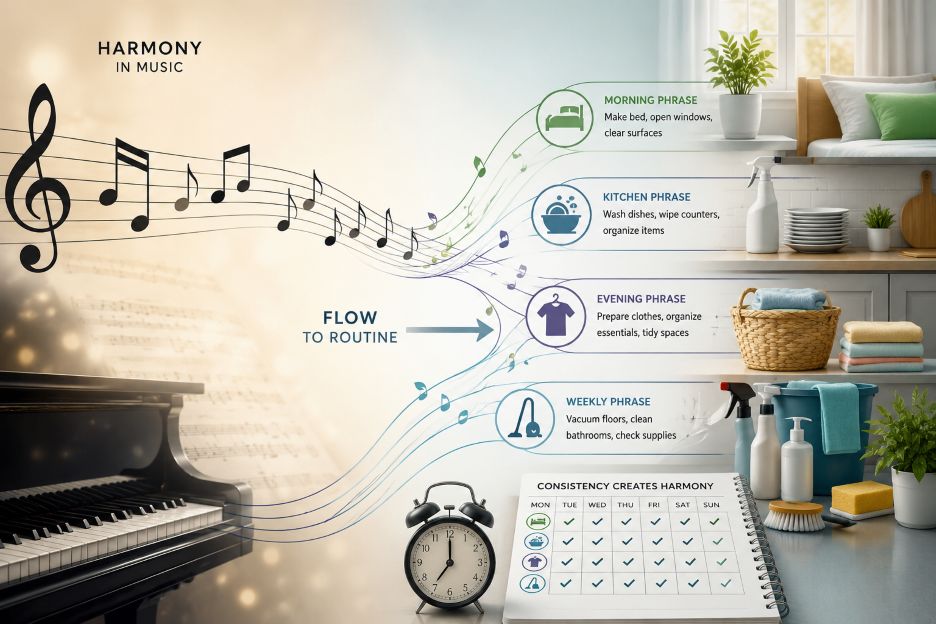
Research shows that structured routines reduce mental strain and improve consistency in daily activities. Findings published by the American Psychological Association suggest that repeated behaviors can lower decision fatigue because people spend less energy deciding what to do next. Daily maintenance tasks often fail because people do not always struggle with effort itself. More often, they struggle with disorder, interruptions, and the feeling that responsibilities arrive all at once.
Many systems that guide organized upkeep rely on repeatable patterns rather than random action. As a reference for household maintenance practices, Regular Home Care (الرعاية المنزلية المنتظمة) illustrates how structured attention to routine tasks can support consistency over time. Despite the importance of routine, many people approach maintenance in fragments. One task is completed today, another is postponed until next week, and a larger list slowly forms in the background.
These disruptions create a familiar cycle. Small duties pile up, attention shifts repeatedly, and the process begins to feel larger than it really is. Music offers an interesting way to understand this problem. Musical phrasing organizes notes into manageable patterns that create rhythm and flow. Daily upkeep can be approached in a similar way.
Understanding the Problem of Disrupted Routines
People often assume maintenance becomes difficult because there is too much work. However, experts note that inconsistency frequently creates a greater problem than workload itself. A kitchen cleaned every few days may require little effort. A kitchen left untouched for several weeks often feels overwhelming.
Consider how interruptions affect ordinary tasks. Someone begins sorting laundry but stops midway to answer messages. They move to another room and remember dishes waiting in the sink. Soon, multiple unfinished tasks compete for attention.
Daily life contains many distractions. Phones, work demands, family responsibilities, and unexpected events regularly interrupt concentration. Without structure, maintenance activities become isolated actions rather than connected routines.
Music faces a similar challenge. Individual notes scattered without order can sound disconnected. Musicians solve this issue through phrasing. Notes are grouped into meaningful segments that guide rhythm and movement.
The same principle can create order in maintenance routines.
Breaking Down “Phrasing” in Daily Tasks
Musical phrasing refers to grouping notes into sections that feel complete. Instead of treating every note separately, performers create connected ideas that listeners can follow naturally.
Daily upkeep can use the same method.
Rather than viewing maintenance as one large responsibility, smaller connected groups can be created. Think of these groups as routine phrases.
Examples of Maintenance Phrases
- Morning phrase: Make the bed, open windows, clear surfaces.
- Kitchen phrase: Wash dishes, wipe counters, return items to storage.
- Evening phrase: Prepare clothes, organize essentials, tidy common spaces.
- Weekly phrase: Vacuum floors, clean bathrooms, inspect household supplies.
Each phrase becomes a complete unit. The goal is not speed. The goal is creating a pattern that feels predictable.
Behavior researchers at University College London found that habits generally develop through repeated actions linked to context and cues. Repetition strengthens familiarity. Over time, tasks begin requiring less conscious effort.
Breaking maintenance into phrases reduces the feeling of confronting one enormous list.
Applying Structured Repetition Step by Step
Once maintenance phrases are identified, repetition becomes the next step. Music relies heavily on repeated patterns because repetition creates memory and stability. Daily upkeep follows a similar process.
Step 1: Identify Recurring Tasks
Begin by writing down activities that repeatedly appear throughout the week.
- Cleaning surfaces
- Organizing clothes
- Removing clutter
- Checking supplies
- Managing laundry
Focus on tasks that naturally return rather than occasional responsibilities.
Step 2: Group Similar Activities
Avoid placing unrelated tasks together. Similar activities create smoother transitions.
For example, cleaning kitchen counters and washing dishes belong naturally within one sequence. Paying bills and organizing shelves may require different levels of attention.
Smooth transitions reduce mental switching costs. Research from the American Institute of Stress suggests that frequent task-switching may reduce productivity and increase perceived stress.
Step 3: Establish Timing Cues
Musicians rely on timing. Daily routines also benefit from consistent cues.
Examples include:
- Starting a short reset after breakfast
- Organizing shared spaces before dinner
- Completing preparation tasks before bedtime
Timing cues help routines become automatic rather than dependent on memory alone.
Step 4: Keep Patterns Flexible
Musical performance follows structure while allowing room for expression. Maintenance routines should work the same way.
Unexpected meetings, family needs, or schedule changes happen regularly. Missing a routine occasionally does not mean the system has failed.
The purpose is consistency over time rather than perfect execution every day.
Maintaining Harmony Over Time
Long-term consistency requires attention beyond the first few weeks. Initial motivation often fades because new systems can feel exciting at the beginning and ordinary later. Discussions around how clean environments influence creative rhythm also reflect a broader idea that surroundings can shape focus and behavioral patterns. Organized spaces often support clearer thinking, which can make routine activities feel easier to maintain over time.
Experts from Harvard Health Publishing note that sustainable habits often depend on manageable goals rather than dramatic changes. Small actions repeated consistently tend to last longer.
Maintenance systems should evolve naturally as circumstances change.
Someone living alone may use shorter routine cycles. Families with children may need larger household patterns involving shared responsibilities. Seasonal changes may also alter priorities.
Scheduled home maintenance practices, recurring household care systems, and organized upkeep habits all work best when they remain adaptable.
Regular review helps maintain balance. Every few weeks, ask simple questions:
- Which tasks feel easy?
- Which routines feel rushed?
- Which activities repeatedly get delayed?
Adjustments prevent frustration from building slowly over time.
Music rarely depends on individual notes standing alone. Meaning emerges through connection, timing, and repetition. Daily upkeep works in much the same way. A home, workspace, or shared environment often stays manageable when maintenance becomes a sequence rather than a collection of unrelated tasks.
Consistent household routines and ongoing care practices create rhythm within daily life. Instead of responding to disorder after it grows, people can build simple patterns that support steady maintenance. Harmony, whether in music or everyday responsibilities, usually develops through small actions repeated with intention.
The result is not perfection. The result is flow.